
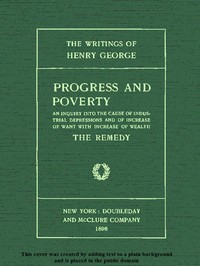
Progress and Poverty, Volumes I and II by Henry George
Let's be clear: Progress and Poverty isn't a novel. There's no main character named Jack fighting a dragon. The "story" here is the puzzle of human civilization itself. Henry George sets the stage with a simple, haunting observation: as America industrialized and grew richer in the late 1800s, poverty didn't disappear—it seemed to get worse. This is the core mystery. How can we have so much progress, so much new wealth, and still have so much need?
The Story
George acts as our guide, walking us through the usual economic explanations and showing why they don't quite fit. He builds his case piece by piece. He explains the difference between capital (things we build, like factories) and land (the earth itself, which no one made). His big idea is that land has a unique power. Its value doesn't come from the owner's work, but from the community around it—the roads, schools, and businesses everyone builds together. Yet, our system lets private landowners pocket that rising value as rent. George argues this creates a dangerous cycle. As a community grows and land values soar, the reward for simply owning land can outpace the reward for actual work or innovation. This pushes wages down and makes basic living, especially housing, brutally expensive. The final act of his story is his proposed fix: replace most taxes with one single tax on the value of land itself.
Why You Should Read It
You should read this because it will change your lens on the world. It connects dots between things that often seem separate: your high rent, a tech billionaire's wealth, and a homeless encampment. George writes with a fiery, almost preacher-like passion for justice. You can feel his outrage on the page, and it's contagious. Even 150 years later, his analysis feels eerily relevant when we talk about housing crises, wealth inequality, and the feeling that the economy is rigged. It makes you question fundamental assumptions you didn't even know you had.
Final Verdict
This book is perfect for curious readers who enjoy big, challenging ideas—fans of writers like Thomas Piketty, Jane Jacobs, or Malcolm Gladwell when he's in serious mode. It's for anyone frustrated by economic debates that go in circles. It's also a fascinating historical artifact, showing that our current struggles aren't new. Be warned: it's dense in parts and requires some focus. But if you stick with it, you'll be rewarded with one of the most original and persuasive frameworks for understanding the modern world ever written. You might not adopt his "Single Tax" solution, but you'll definitely start seeing the hidden role of land in every headline about inequality.
The copyright for this book has expired, making it public property. Thank you for supporting open literature.
Ashley Harris
1 year agoText is crisp, making it easy to focus.
Matthew Garcia
2 months agoAfter finishing this book, it provides a comprehensive overview perfect for everyone. I will read more from this author.
Linda Jones
11 months agoComprehensive and well-researched.
Ethan Wilson
2 years agoFrom the very first page, it manages to explain difficult concepts in plain English. Absolutely essential reading.


Elizabeth Scott
1 year agoPerfect.