
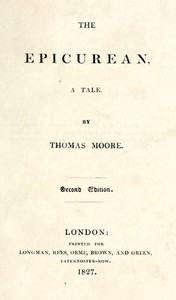
The Epicurean: A Tale by Thomas Moore
Published in 1827, Thomas Moore's 'The Epicurean' is a novel that feels both of its time and strangely timeless. It’s not a dry history lesson; it’s a vibrant, sensory journey into a pivotal moment of human thought.
The Story
We meet Alciphron, a wealthy and brilliant young Athenian philosopher who subscribes to the Epicurean school—which, contrary to popular belief, isn't just about feasting. It's about seeking a life free from pain and fear. Yet, Alciphron feels a restless emptiness. Hearing legends of an ancient, purer wisdom preserved in Egypt, he disguises himself and travels down the Nile.
His quest leads him into the heart of a surviving temple of Isis, where he encounters the beautiful and devout priestess, Alethe. What begins as intellectual curiosity—and maybe a bit of espionage—blooms into a deep, forbidden love. Alciphron is torn between his philosophical beliefs, which view her religion as superstition, and his growing passion. The central conflict isn't with a villain, but within himself: Can his philosophy, built on reason and the pursuit of calm pleasure, survive a collision with profound love and mystical faith?
Why You Should Read It
Moore gets the big stuff right. He makes you feel the heat of the Egyptian sun and the cool silence of the temple halls. But more importantly, he makes Alciphron's internal struggle matter. This isn't just about ancient Greeks and Egyptians; it's about anyone who has ever had a firmly held belief challenged by a powerful new experience. Is love the highest form of pleasure, or a dangerous distraction from peace? Is faith a comfort or a trap? Moore doesn't give easy answers, but he asks the questions in a way that sticks with you.
The romance with Alethe is genuinely moving because it's built on a clash of worldviews. You root for them, even as you see how impossible their situation seems.
Final Verdict
This book is perfect for readers who love historical fiction with a philosophical bent, but hate feeling like they're back in school. It’s for anyone who enjoys a thoughtful love story where the biggest obstacle isn't a parent or a rival, but the characters' own deepest convictions. If you liked the spiritual quest in The Alchemist but wished it had more historical texture and romantic tension, you’ll find a lot to love here. Be prepared for a slower, richer pace—it’s a novel to savor, not speed through. In the end, 'The Epicurean' is a beautiful, melancholic exploration of what we search for when the old answers aren't enough anymore.
There are no legal restrictions on this material. You can copy, modify, and distribute it freely.
Susan Anderson
1 year agoI didn't expect much, but the content flows smoothly from one chapter to the next. Exactly what I needed.
Ashley Young
7 months agoVery helpful, thanks.
Jennifer Perez
10 months agoBeautifully written.










Oliver Martinez
2 years agoAfter finishing this book, the depth of research presented here is truly commendable. Thanks for sharing this review.