
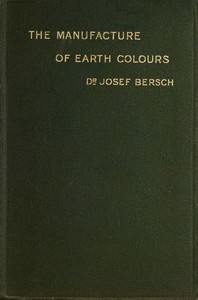
The manufacture of earth colours : With thirty-one illustrations by Josef Bersch
Let's be clear from the start: Josef Bersch's The Manufacture of Earth Colours is not a novel. You won't find a twisting plot or deep character arcs. Instead, the book is a detailed, step-by-step guide to an almost forgotten art: making permanent pigments from the very ground beneath our feet.
The Story
Think of it as a recipe book, but for colors. Bersch, writing in 1907, walks us through the entire process. He starts with the raw materials—specific types of ochre, sienna, and umber dug from mines and quarries across Europe. He describes how to identify the best deposits, how to wash and purify the raw earth, and then the real alchemy begins: the calcination (or roasting) of these clays. This is where the magic happens. A dull yellow raw sienna, when heated, transforms into the deep, warm brown of burnt sienna. The book explains the grinding, the levigation (washing to separate fine particles), and finally, the careful preparation of the pigment for use in paints and artists' materials. The thirty-one illustrations are crucial, showing furnaces, grinding mills, and the stunning results of this transformation from dirt to art.
Why You Should Read It
I picked this up out of historical curiosity, but I was completely charmed. In our world of mass-produced, synthetic everything, Bersch's meticulous focus is refreshing. This book is about connection—connecting art to geology, the painter's studio to the landscape. It makes you appreciate the sheer labor and knowledge embedded in a single tube of paint. Reading about artisans patiently washing pigment in a series of settling tanks feels meditative. It’s a powerful reminder that beauty often comes from the most humble beginnings, and that permanence is something you have to work for. Bersch’s passion is quiet but evident on every page; he isn't just giving instructions, he's preserving a craft he deeply respects.
Final Verdict
This is a niche gem, but a brilliant one. It's perfect for artists, historians, or anyone fascinated by old-world craftsmanship. If you love books that explain how things are made, from scratch, you'll be engrossed. It's also a great pick for readers who enjoy slow, detail-rich nonfiction that changes how you see ordinary things—like a handful of dirt. It's not a page-turner in the traditional sense, but as a window into a vanished industrial art, it's utterly captivating. Just be prepared to look at the browns and yellows in old paintings with a lot more wonder.
Legal analysis indicates this work is in the public domain. You do not need permission to reproduce this work.
Richard Williams
1 year agoThe digital formatting makes it very easy to navigate.
Donald Brown
2 years agoHaving followed this topic for years, I can say that the breakdown of complex theories into digestible segments is masterfully done. It cleared up a lot of the confusion I had previously.
John Moore
1 year agoI had low expectations initially, however the atmosphere created is totally immersive. Exactly what I needed.
Sarah Ramirez
6 months agoFive stars!




Mary Thomas
2 years agoWhile browsing through various academic sources, the attention to detail regarding the core terminology is flawless. This adds significant depth to my understanding of the field.